

| Birth | 27 January 1832, Daresbury parsonage, Cheshire |
| Death | 14 January 1898, The Chestnuts, Guildford |
| Alternate names | Lewis Carroll, Uncle Dodgson |
| Addresses |
|
| Parents | Charles Dodgson and Frances Jane Lutwidge |
| Siblings | Wilfred (and 9 others) |
| Spouse/children | N/A |
Biography:
Adapted from Oxford Dictionary of National Biography (“Dodgson, Charles Lutwidge [pseud. Lewis Carroll]”) by Morton N. Cohen, unless otherwise noted.
Charles Lutwidge Dodgson was the eldest son of Charles Dodgson and Frances Jane Lutwidge. His father was a clergyman in the Church of England who eventually rose through the ecumenical ranks from curate to canon. Dodgson spent his earliest years in the parsonage of rural Daresbury and was educated at home until the family moved to Croft-on-Tees, Yorkshire when he was eleven. He exhibited early interest in developing creative ways to pass the time, as well as mathematics and writing, and began writing and producing a family magazine when he was thirteen.
Dodgson did extremely well in school, with seemingly no adverse effects from his lifelong stammer. He enrolled at Christ Church, Oxford in 1851 where he took first-class honors in mathematics and graduated with his BA in 1854. In 1855, Dodgson began lecturing in mathematics at Christ Church and in 1861 was ordained a deacon, which—along with celibacy—was a requirement to be an Oxford don. Dodgson managed to avoid becoming a priest (the final requirement) after discussing his theological concerns with the dean, Henry Liddell.
Though a devout member of the Church of England throughout his life, Dodgson’s relationship to the church and his theological views evolved away from the high church culture of his childhood. He eventually “rejected eternal punishment as a doctrinal certainty” and “embraced the whole of humanity, even those who had never heard of Christ, as children of God [. . .].” Later in his life, he watched a performance of The Merchant of Venice and was so dismayed by Shylock’s ultimate conversion to Christianity that he wrote to his friend the actress Ellen Terry, asking her to change the play’s ending because it was “entirely horrible and revolting to […] all who believe in the Gospel of Love.”
Dodgson’s first publications were poems in the Oxonian Advertiser in 1854, and he first used the pseudonym “Lewis Carroll” (roughly the English to Latin then back to English translation of “Lutwidge Charles”) in March 1856, with his poem “Solitude” in The Train periodical (Carroll). He continued submitting creative and poetic pieces, and his work was featured in a variety of periodicals, including All the Year Round and Punch. Dodgson’s first full book, however—A syllabus of plane algebraical geometry, systematically arranged, with formal definitions, postulates, and axioms (1860)—represented a different passion and was the first of many publications about mathematics, several of which featured the recognizable wit and creativity for which Dodgson came to be internationally recognized.
A seminal event in Dodgson’s life occurred at the intersection of Henry George Liddell’s arrival at Christ Church as dean and Dodgson’s foray into photography in 1856. While photographing Christ Church Cathedral in April, Dodgson encountered Henry Liddell and his three daughters—Lorina, Alice, and Edith—at the deanery and soon afterwards struck up a close friendship with the family. Six years later, as Dodgson and the Liddell girls enjoyed a riverside picnic on 4 July 1862, the children asked for a story and Dodgson spun a tale that would eventually evolve into Alice’s Adventures in Wonderland (1865), a work which dramatically changed children’s literature.[1]
By the end of his life, Dodgson had published over 300 works, taken over 3000 photographs, and logged sending or receiving more than 98,000 letters[2]. But his creativity and ingenuity did not stop there. On top of his better known writing and photography accomplishments, Dodgson was also an inventor and developed a substantial collection of new ideas, both for entertainment (e.g. “Circular Billiards,” “Castle Croquet”) and to serve useful purposes, from a gadget for reading more easily in bed to an improved voting system.
Dodgson remained unmarried, but he had a robust social life. Though he carefully guarded the low profile his pseudonym provided, writing that he had “an intense dislike to personal publicity,” he was often found at London events and galleries, wrote letters nearly incessantly, and developed connections throughout England (Collingwood 309). With notable exceptions where family members seem to have removed or destroyed photographs and diary entries from his files, Dodgson’s prolific letter writing, photography, and diary keeping has been preserved, providing historians and scholars with remarkable detail of his daily activities, social connections,
Charles Lutwidge Dodgson died of pneumonia two weeks before his sixty-sixth birthday.
Relationship to MacDonald:
Friend, photographer
Mutual connections:
F.D. Maurice, John Ruskin, Arthur Hughes, Alexander Munro, Dante Gabriel Rossetti, Mark Twain
History with MacDonald: 1858/’59-1890s
The moment of Charles Dodgson’s first meeting with George MacDonald and his family is difficult to pinpoint. Greville dates the inauguration of the friendship “from the days of Tackleway,” referring to the street in Hastings where the MacDonalds lived from 1857 to October 1859 (GMAW 301). While in Hastings, MacDonald saw local homeopath Dr. Hale, whom Greville calls “our best friend at Hastings,” and—as Greville (somewhat opaquely) further describes—whose “heretical sect in the profession were curiously addicted to philosophic studies and speculations” (GMAW 301). At the same time, Dodgson visited his aunts in Hastings and worked with Dr. James Hunt, PhD, in nearby Ore on curing his stammer. The two doctors shared an interest in philology and were friends, and ostensibly introduced their respective patients to each other, though Dodgson’s meticulous journals from this era are missing, rendering verification challenging (Shaberman 11).[3]
In 1861, when Greville was 5 years old, he modelled for sculptor Alexander Munro for his work “Boy with Dolphin,”[4] a fountain afterwards placed in Hyde Park, London.[5] One day in Munro’s studio, Dodgson came by and encountered Greville and 7-year-old Mary and struck up a whimsical conversation about the benefits of replacing Greville’s head of flesh with a head of marble. Dodgson’s account of the conversation suggests that he previously knew of the MacDonald children but only then began properly establishing himself as the man who would become their “Uncle Dodgson” (Collingwood 83-85; Raeper 169).
As with the Liddells and others, Dodgson sought the company of the MacDonald children and mother at least as much as that of their father. Raeper reports that Mary was his favorite among the children, and “he often took her or her and Lily out to tea or to play croquet” (Raeper 171). In addition to enjoying the MacDonalds’ own theatrical endeavors, Dodgson took Lily and Mary to the Olympic Theatre in the Strand, London. Dodgson must also have introduced his brother to the family: Wilfred Dodgson taught Mary how to box and consequently nicknamed her “the Kensington chicken” (GMAW 466).
For years, Dodgson was a regular among the MacDonalds. Greville records “Uncle Dodgson” taking them to the Royal Polytechnic Institution to view scientific and mechanical innovations every year (GMAW 343). There were visits to the London Colloseum,[6] Cremer Jr.’s European Toy and Game Warehouse, and treats of bath buns and ginger beer. Greville also remembers whimsical drawings from Dodgson to the children, including a humorous cartoon of a couple late for a train and a more personal sketch of Mary and toddling Ronald under an apple tree. When the MacDonalds spent the summer of 1862 with Louisa’s father and sister-in-law Caroline in Aberystwyth, Wales, Dodgson “came several times, and took many photographs [. . .],” and near the beginning of 1865, he reportedly hoped for the MacDonalds’ hospitality in taking in his brother, Wilfred, when he was visiting London for a few months (GMAW 342).
On 9 July 1862, five days after the boat trip that prompted Alice’s Adventures in Wonderland, Dodgson records that he “met Mr MacDonald” exiting Tudor Lodge, and the two men walked together while MacDonald showed Dodgson one of Arthur Hughes’ drawings for The Light Princess, which he was on his way to publish (Raeper 173).
In the spring of 1863, Dodgson sent a draft of Alice’s Adventures under Ground (the story’s title before Wonderland was developed) to MacDonald, requesting feedback (Carpenter 57). MacDonald directed the query to his children, and when Louisa finished reading the last page of the manuscript aloud, six-year-old Greville immediately announced that “there ought to be sixty-thousand volumes of it” (GMAW 342). With the enthusiasm of the MacDonald children behind him, Dodgson moved forward with his project, and Alice’s Adventures in Wonderland was introduced to the world in 1865.
That July, as the MacDonalds visited with Grandfather Powell at Elm Lodge in Elm Row, Hampstead, Dodgson also joined for a photography visit.[7] On the first night of his visit, Dodgson found himself locked out of the house after returning late from the theatre, and – unable to rouse anyone – walked back to London to find a room in the wee hours of the morning (Raeper 172). That Sunday, the whole party visited the chapel of St. Peter on Vere Street, where F.D. Maurice was the minister between 1860-1869, and Maurice returned home with them for lunch and to be photographed by Dodgson. Dodgson noted in his diary that he had “now done all the MacDonalds” on 31 July, and on that day took Mary to Arthur Hughes’ studio so she could pose for a painting – a painting Dodgson would see displayed two years later (5 July 1865) at the Royal Academy, finalized as Beauty and the Beast (now in a private collection) (Raeper 172). After photographing Irene MacDonald the next year, in 1864, Dodgson commissioned Henry Darvall, an artist with a Pre-Raphaelite aesthetic, to paint a version of the photograph.
Dodgson’s letters to the MacDonalds reflect his whimsical personality. In October 1863, a month after the MacDonalds moved from Tudor Lodge to 12 Earles Terrace, Kensington, Dodgson set out to visit them[8]. Initially failing his quest, he wrote to Louisa, “I have made an effort [. . .] to find your new house. I found an Earl Street, but the aborigines themselves didn’t know of anything else beginning with ‘Earl.’ I mean to start again soon, taking a bag of provisions, an axe, and other essentials for a traveller exploring in unknown regions” (Raeper 179). In May of the following year, Dodgson wrote to Mary MacDonald (then ten-years-old):
This hot weather makes me very sad and sulky. I can hardly keep my temper sometimes. For instance, just now the Bishop of Oxford came in to see me – it was a civil thing to do, and he meant no harm, poor man: but I was so provoked at his coming in that I threw a book at his head, which I am afraid hurt him a good deal. (Raeper 171)
The overlap of Dodgson’s relationship with the MacDonalds and his writing of Through the Looking-Glass seeps out in the same letter, with gestures towards the White Queen’s believing “as many as six impossible things before breakfast.” Lilia MacDonald is reimagined as “Lily,” the daughter of the white queen, and Mary’s white cat appears as Alice’s cat Dinah’s white kitten (Raeper 171-72).
When looking for an illustrator for Through the Looking-Glass in April 1868, Dodgson asked MacDonald for an introduction to Sir Noel Paton, which MacDonald provided, though Paton turned down Dodgson’s offer, telling him that “Tenniel is the man.” MacDonald admired Tenniel’s illustrations in an earlier edition of Undine, and—despite looking elsewhere initially—Dodgson ended his search back where he started: with John Tenniel (Raeper 173).
Though Dodgson and the MacDonalds were closest during the 1860s, their friendship spanned decades. When Mary and Ted Hughes got engaged in 1874, Dodgson wrote to her, “They say that, when people marry, they generally find it best to drop all their former friends, and begin again with a new set. Is it a universal rule, I wonder? And does it include very old friends as well as new ones?” He concluded by saying that, for Mary to be “truly happy in your marriage and in all your future life is the hope and prayer of your loving Uncle. C. L. Dodgson” (Raeper 335).
Dodgson also enthusiastically supported the MacDonald family forays into theatre. Having helped fan the flame of their love for theatre as children, it makes sense that he watched their family productions of Pilgrim’s Progress repeatedly, even if—as he wrote in his diary on 26 July 1879—“Lily appeared in all the pieces, and was the only one who could act.”[9] At one point, Dodgson attempted to arrange for the MacDonald troop to perform in Oxford, though the venue logistics never came together.
Dodgson’s friendship with the MacDonalds lasted through the final decade of his life (Raeper 178).
Sources:
Carpenter, Humphrey. Secret Gardens: A Study of the Golden Age of Children’s Literature. 1985. Houghton Mifflin.
Carroll, Lewis. “Solitude.” The Train: A First Class Magazine, vol. 1. London. Pp. 154-55. https://babel.hathitrust.org/cgi/pt?id=uc1.b5235211&seq=164.
Cohen, Morton N. “Dodgson, Charles Lutwidge [pseud. Lewis Carroll].” Oxford Dictionary of National Biography. 3 October 2013. Oxford University Press. https://www-oxforddnb-com.ezproxy.mtsu.edu/view/10.1093/ref:odnb/9780198614128.001.0001/odnb-9780198614128-e-7749.
Collingwood, Stuart Dodgson. The Life and Letters of Lewis Carroll (Rev. C. L. Dodgson). Cambridge: Cambridge University Press, 2011. Print. Cambridge Library Collection – Literary Studies.
MacDonald, George. An Expression of Character: The Letters of George MacDonald. Edited by Glenn Sadler, William B. Eerdman’s Publishing Company, 1994.
MacDonald, Greville. George MacDonald and His Wife [GMAW]. Unwin Brothers, Ltd. 1924.
Raeper, William. George MacDonald. Lion Publishing Place, 1987.
Sadler, Glenn, editor. An Expression of Character: The Letters of George MacDonald. William B. Eerdman’s Publishing Company, 1994.
Shaberman, R.B. “George MacDonald and Lewis Carroll.” North Wind: A Journal of George MacDonald Studies: Vol. 1, Article 1. January 1982. http://digitalcommons.snc.edu/northwind/vol1/iss1/1.
Timbs, John. Curiosities of London. London: David Bogue. 1855. https://www.google.com/books/edition/Curiosities_of_London/.
Image:
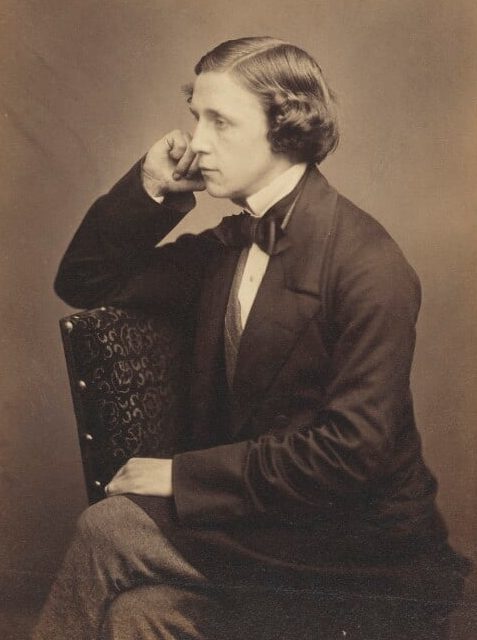
Carroll, Lewis. “Lewis Carroll.” 2 June 1857. National Portrait Gallery. https://www.npg.org.uk/collections/search/portrait/mw01891/Lewis-Carroll?
Notes:
[1] Dodgson denied that Alice Liddell was particular inspiration for the Alice from Wonderland, but that remains the popular understanding among the public and many scholars.
[2] He once wrote, “I’m beginning to think that the proper definition of ‘Man’ is ‘an animal that writes letters’” (qtd. in Cohen).
[3] There is some confusion among the available data: Greville was only three and a half year old when the MacDonalds initially left Hastings and is unlikely to remember much; Raeper says the two men may have met in April of 1860 when the MacDonalds temporarily returned from London; Sadler’s timeline places “GMD meets Charles Dodgson [Lewis Carroll]” in 1862 (p. 48).
[4] Munro’s sculpture is of a boy with a dolphin, but I have not found a definitive answer to the name of the artwork. I have found it referenced as “Boy with Dolphin” most frequently, but also “Boy with a Dolphin, and “Boy and Dolphin.”
[5] Collingwood places this incident towards the end of 1860; Greville puts it in 1861. Dodgson’s original journal is currently missing, neither account references a specific date, and both use approximating language.
[6] Greville spells this “Coliseum,” but the “London Coliseum” was a theatre built in 1904, while the “London Colloseum” was a building in Regent’s Park between 1827 and 1875 that housed Thomas Horner’s “Panoramic View of London” painting (Timbs 221).
[7] On a second occasion that year, in October, Dodgson visited and photographed the MacDonalds, this time also including the Arthur Hughes family and others.
[8] Greville erroneously indicates that the move from Tudor Lodge to Earles Terrace was in 1862 (GMAW 345).
[9] The same diary entry describes meeting Mark Twain (“Mr Clemons”), seemingly at that same production of Pilgrim’s Progress.