

| Birth | 23 July 1853, Arundel, England |
| Death | 27 April 1878, Villa Cattaneo, Nervi, Italy |
| Alternate names | Molly, Elfie, Blackbird, “The Kensington Chicken” |
| Addresses |
|
| Parents | George MacDonald and Louisa Powell MacDonald |
| Siblings |
|
| Fiancé | Edward R. “Ted” Hughes |
Biography:
Compiled from variety of sources, cited throughout.
Mary Josephine MacDonald was born in Arundel, England, at the end of the young MacDonald family’s time in Sussex. The second of MacDonald’s eleven children, Raeper describes her as a “frail” and “waifish” toddler, who consequently had to accompany George and Louisa on their first trip to Algiers in 1856 instead of staying behind with Lilia (at Aunt Charlotte Godwin’s), or with Grace and Greville (at Aunt Caroline’s at The Limes) (Raeper 137).
As she grew, Mary—keeping with the MacDonald family values of art and imagination—took singing lessons with Lilia and participated enthusiastically in acting and performing, not only in the family’s traveling production of The Pilgrim’s Progress, but in living room dramas like Cinderella and cheeky imitations of various family members and friends (MacDonald Family Album 15).
From childhood, Mary exhibited a spirited and strong character. Alongside her creative activities, Mary was unique amongst her siblings in her relish of sport and movement (Raeper 170). While teaching her how to box, Wilfred Dodgson (Charles L. Dodgson’s brother) nicknamed her “The Kensington Chicken,” and Greville considered her “the most muscular of the family” (GMAW 466). Mary also modeled for family friend (and MacDonald’s illustrator) Arthur Hughes, notably on 31 July 1863 after “Uncle [Charles] Dodgson” finished photographing the MacDonald family in the morning and then took Mary to the Hughes’ studio so that she could pose for what would become his 1865 painting Beauty and the Beast (Raeper 172).
Mary seems to have had her share of darker moods, though. In early 1869, George sent letters both to Louisa and to 15-year-old Mary directly in which he references a “gloominess” that Mary was prone to. He encouraged her to not be overcome by the difficulties of life, but to remember not to let “the dull weather over-cloud the fine” (qtd. in GMAW 390).
Around this time, Edward R. Hughes (“Ted”) began spending substantial time with the MacDonald family while assisting his uncle, the MacDonalds’ close friend and illustrator Arthur Hughes, with various art projects. During the winter of 1873/74, Mary—then twenty—and Ted were engaged. Louisa, delighted to gain Ted as another son, wrote in February that he had “loved our Molly for eight years – & with that one steady hope of some day winning her – has worked on & on.” (Transcript, Feb. 1874). But soon after their engagement, Mary contracted scarlet fever, which weakened her lungs and sapped her strength. From that point until the end of her life, Mary joined her father in experiencing chronic poor health and bronchial difficulties.
In an attempt to escape the damp and dirty air of England, the MacDonalds journeyed to the coast of Italy, renting “Villa Cattaneo” in Nervi, Italy in 1877. By this time, Mary’s condition had deteriorated beyond a reasonable hope and the family was coming to terms with the prospect of losing her. Ted still visited regularly, and the family took an unusual number of family photos that featured both Ted and Mary—perhaps anticipating the approaching day when the family could no longer gather, whole, in the same room.
The following spring, in Nervi, after four years of weakness and wasting away, until George described her as having “nothing on her dear bones,” Mary died of tubercular illness on April 27, 1878[1] at the age of twenty-four (Transcript). She was surrounded by her family and Ted, who had hurried to Italy when notified that his fiancée’s end was near. She was the first of the eleven children to die, and both Greville and George wrote of the anguish her death caused the family, and Louisa in particular.
Relationship to MacDonald:
Daughter
History with MacDonald:
Mary had a loving relationship with her father, who had a trove of affectionate nicknames for her, most frequently addressing his letters to “Elfie.” But his joy at her engagement to Ted Hughes soon turned to sorrow at the onslaught of her initial illness and subsequent inability to regain her strength. Increasingly towards the end of her life, MacDonald’s letters to and about her have a mournful yet resigned tone to them: sending his love to his “little sick dove,” affectionately recalling “the lark’s nest [he] found the morning she was born,” and having to consider making another lecture tour in North America if and when she did die (qtd. in GMAW 475; Transcript, Feb. 1878). On 7 April 1878, just under three weeks before her death, MacDonald wrote to close friend Georgina Cowper-Temple, “I can hardly trust myself to write about our Mary. But God is with her, and she clings to him. Surely he will take her as easily as may be consistent with her good entrance into the more abundant life. She is very weak now – and nothing on her dear bones.” Reflecting upon her death, Greville later wrote of his parents, “Perhaps, I dare suggest, they did not find it easier to face than do those whose faith fails them utterly in striving to penetrate the veil” (qtd. in GMAW 483).
Although the family had moved to Italy for the sake of Mary’s health, the warm seaside had such a positive effect on George’s chronically weak lungs that, when combined with the significantly reduced cost of living compared to London, it was settled that they would remain for a time. Eventually, the family left Nervi to build their home Casa Coraggio in Bordighera, a town a few miles west that would eventually become a popular destination for friends and admirers of George MacDonald.
Sources:
George MacDonald Collection. General Collection, Beinecke Rare Book and Manuscript Library, Yale University. https://archives.yale.edu/repositories/11/resources/525.
MacDonald Family Album, n.d. George MacDonald Collection. General Collection, Beinecke Rare Book and Manuscript Library, Yale University. https://archives.yale.edu/repositories/11/archival_objects/169673.
MacDonald, George. An Expression of Character: The Letters of George MacDonald. Edited by Glenn Sadler, William B. Eerdman’s Publishing Company, 1994.
MacDonald, Greville. George MacDonald and His Wife [GMAW]. Unwin Brothers, Ltd. 1924.
Raeper, William. George MacDonald. Lion Publishing Place, 1987.
Transcript letter from George MacDonald to Georgina Cowper Temple. February 17, 1878. George MacDonald Papers, Binder 2, Marion E. Wade Center, Wheaton College, Wheaton, IL.
—-. April 7, 1878. George MacDonald Papers, Binder 2, Marion E. Wade Center, Wheaton College, Wheaton, IL.
Transcript letter from Louisa MacDonald to Charlotte Powell Godwin. February 7, 1874. George MacDonald Papers, Binder 1, Marion E. Wade Center, Wheaton College, Wheaton, IL.
Image:
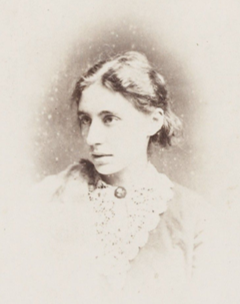
“M.J.M.D.” MacDonald Family Album, n.d., p. 23. George MacDonald Collection. General Collection, Beinecke Rare Book and Manuscript Library, Yale University. https://archives.yale.edu/repositories/11/archival_objects/169673.
Notes:
[1] Greville lists April 27, 1878 in George MacDonald and His Wife (483). Sadler lists April 28, 1878 in a footnote in Expressions of Character (281).